
Blog.
The Future of Technology:
Trends to Watch
Best Payroll Services for Restaurant Groups With Multiple Locations
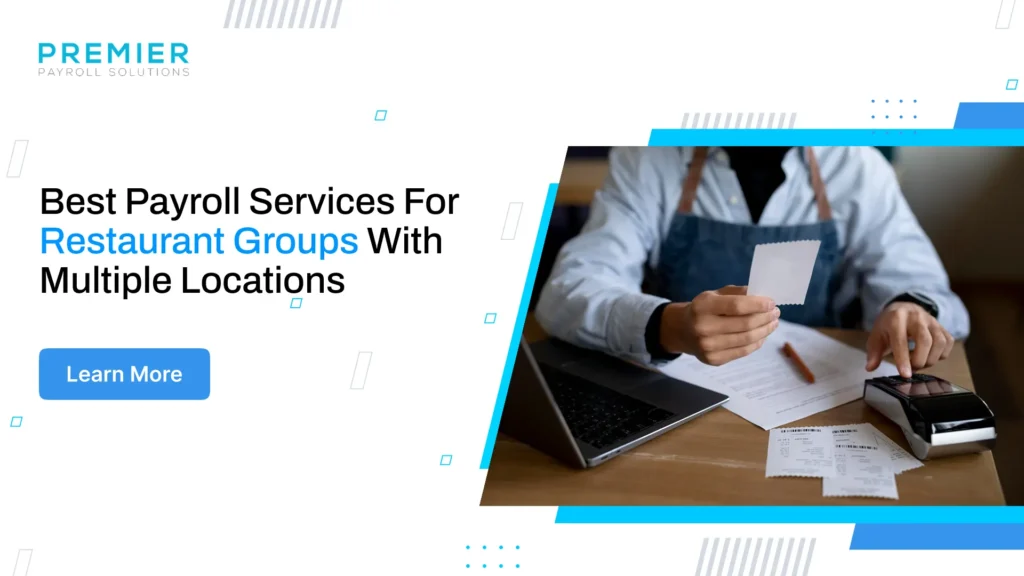
Best Payroll Services for Restaurant Groups With Multiple Locations
Compare what matters in the best payroll services for restaurant groups: payroll consolidation, tips, compliance, reporting, and support.
Security Guard Payroll Software: 7 Features for Overnight, Multi-Site, and Union Teams
Payroll Integration Checklist: Connect HR, Time, Benefits, and Accounting Without Duplicate Data
Open Enrollment Software Checklist: What to Fix Before Q4 Benefits Season

Best Time and Attendance Software for Small Businesses: A Payroll-First Checklist
Running one restaurant is hard. Running five locations with different managers, schedules, tip pools, and payroll deadlines can feel like a weekly fire drill.
If you are searching for the best payroll services, you are probably not looking for another basic payroll app. You want payroll for multiple locations that stays accurate at the store level, but still rolls up cleanly for corporate reporting, taxes, and cash planning.
This guide breaks down what “best” really means for restaurant groups, where most payroll setups break, and how to choose a provider that can handle restaurant payroll consolidation without slowing your operations down.
Table Of Contents
- Why Multi-Location Restaurant Payroll Gets Complicated Fast
- What “Best Payroll Services” Means For Restaurant Groups
- Payroll For Multiple Locations: Features That Matter Most
- Restaurant Payroll Consolidation: A Practical Workflow
- Flat-Fee vs Per-Employee Pricing: How Groups Avoid Surprise Costs
- Why Premier Payroll Solutions Fits Multi-Location Restaurant Groups
- FAQs
- Conclusion
- Key Takeaway
Why Multi-Location Restaurant Payroll Gets Complicated Fast
Multi-location payroll problems usually come from one issue: your data is scattered.
Hours live in one system, tips live in the POS, manager approvals happen in texts, and corporate needs a consolidated view that does not match what the store exported. The result is predictable.
- More manual edits right before payroll submission
- More off-cycle checks and corrections
- More confusion when an employee works shifts at two locations
- More time spent reconciling payroll to accounting
The best payroll services for restaurant groups solve this by creating one clean workflow, with controls at the location level and visibility at the corporate level.
What “Best Payroll Services” Means For Restaurant Groups
“Best” is not about brand recognition. It is about fit.
For restaurant groups, the best payroll services usually deliver six outcomes:
- One place to run payroll across all locations, without running five separate processes
- Location-specific rules applied automatically (tips, rates, overtime logic, and tax jurisdictions)
- Faster approvals and fewer payroll week surprises
- Clean reporting by location, brand, and entity
- Tip compliance support that stands up to scrutiny
- Real support when something breaks on a Friday afternoon
Many roundups focus on feature lists. A restaurant group needs something more specific: a system and service model designed for multi-unit operations.
Payroll For Multiple Locations: Features That Matter Most
Multi-Entity And Multi-EIN Payroll
As restaurant groups grow, they often add entities. Sometimes it is for the ownership structure. Sometimes it is by brand. Sometimes it is for different states. Payroll needs to handle that structure without turning into a spreadsheet.
When you evaluate providers, ask if they support:
- Multiple EINs and entities under one master account
- Shared employees who work across locations, with correct allocation
- Separate tax filing by entity, with consolidated reporting for corporate
This is foundational for restaurant payroll consolidation because it prevents the “different location, different payroll system” trap.
Location-Level Approvals With Corporate Oversight
Multi-location payroll does not fail because managers do not care. It fails because approvals are inconsistent.
Look for a provider that supports:
- Store-level review of punches, tips, and exceptions
- Clear approval deadlines and reminders
- Corporate-level visibility into exceptions before payroll submits
- Role-based permissions, so managers cannot accidentally change global settings
POS, Time, And Scheduling Integrations
If your payroll team is re-keying hours or tips, your payroll process is already at risk.
Top restaurant payroll setups pull:
- Hours from time and attendance
- Credit card tips and service charges from the POS
- Job roles and pay rates from your employee records
This is also where a service-led partner helps, because integrations are not just a checkbox. They need to be configured and maintained. Premier Payroll Solutions highlights POS integration as a core component of its restaurant payroll services.
Tip Reporting, Tip Pools, And Service Charges
Tips are where restaurant payroll gets uniquely sensitive.
At the federal level, the U.S. Department of Labor allows tip pooling under the FLSA, but the rules depend on whether the employer takes a tip credit and who is included in the pool.
On the tax side, the IRS makes it clear that tip income is taxable, and cash tips of $20 or more in a month (from one employer) must be reported to the employer.
For larger food or beverage establishments, Form 8027 may also apply, which is exactly why clean POS and payroll records matter as you scale.
A multi-location payroll provider should be able to:
- Pull and categorize tips correctly (cash vs credit card, tips vs service charges)
- Support tip pooling or tip-out rules aligned to your policy
- Keep accurate pay stubs and year-end reporting
- Help you stay organized for audits and tax filings
If you are evaluating “best payroll services,” this is a key differentiator between restaurant-ready payroll and generic payroll.
Multi-State And Local Tax Setup
Multi-location often becomes multi-state faster than owners expect, especially with expansion, seasonal staff, and managers who travel.
ADP’s multi-state payroll guidance emphasizes that employers need to track where employees are physically working and keep pace with changing state payroll tax laws, which becomes harder as locations and work patterns expand.
Even if you are not multi-state today, choose a provider that can scale into that reality without forcing a full migration later.
Consolidated Reporting, Labor Cost Visibility, And GL Export
For restaurant groups, payroll is not only about paying people. It is about labor cost control and clean books.
Look for reporting that supports:
- Location-level labor reporting for managers
- Roll-up views by brand and by entity for the corporate
- Easy exports to accounting, with consistent mapping
- A repeatable close process each pay period
This is where restaurant payroll consolidation pays off: fewer hours spent on reconciliation and more confidence in labor KPIs.
Security, Permissions, And Audit Trails
When multiple managers touch payroll-adjacent data, access control matters.
Ask about:
- Role-based permissions
- Approval logs and audit trails
- Secure employee self-service (pay stubs, tax forms)
These are not “enterprise extras.” They are what keep multi-location payroll stable.
Restaurant Payroll Consolidation: A Practical Workflow
Here is a real-world consolidation workflow that works for many restaurant groups.
Step 1: Standardize Pay Codes And Job Roles
Define consistent roles and pay codes across locations (server, bartender, host, kitchen, manager). This reduces errors when employees move between stores.
Step 2: Connect POS And Time Data
Integrate your POS and time tracking so hours and tip data flow into payroll with minimal manual entry.
Step 3: Store Managers Review Exceptions
Managers review:
- Missed punches
- Overtime flags
- Tip pool outputs
- Shift transfers between locations
Step 4: Corporate Reviews A Single Exception Report
The corporation does not need five emails. They need one dashboard that shows exceptions across all locations.
Step 5: Run Payroll Once, Not Location By Location
The goal is one payroll run that still preserves location-level accuracy.
Step 6: Export Clean Reports For Labor And Accounting
Location managers get what they need for scheduling and labor. Corporate gets consolidated reporting for finance.
If your current setup cannot support this, your team is not failing. Your system is simply not designed for payroll for multiple locations.
Flat-Fee vs Per-Employee Pricing: How Groups Avoid Surprise Costs
Pricing matters more for restaurant groups because headcount and turnover move constantly.
In many payroll models, costs rise with:
- Per-employee fees during seasonal spikes
- Charges for off-cycle payroll runs
- Fees for year-end forms or corrections
- Extra charges for integrations
If you want predictable costs, ask providers to explain:
- What is included in the base price
- What triggers additional fees
- Whether payroll corrections and off-cycle runs are included
- Whether support is included or tiered
Premier Payroll Solutions positions its approach as service-led payroll with transparent pricing and a consultation-first process.
Why Premier Payroll Solutions Fits Multi-Location Restaurant Groups
If you are actively comparing providers, Premier’s restaurant payroll positioning aligns well with multi-location needs.
Restaurant-Focused Payroll Support
Premier’s Restaurant Payroll Services is built around hospitality realities like shifting schedules, POS data, and reducing payroll errors through better integration.
Integrations That Support Real Operations
Premier’s Integrated Payroll System approach focuses on plugging payroll into the systems that already run your business, which is critical for restaurant payroll consolidation.
A Process Designed For Implementation
Premier’s “Discover” and “Game Plan” service workflow matters for multi-location rollouts, because implementation is where most payroll projects fail.
A Strong Next Step For Transactional Intent
If you are ready to evaluate fit, the next step is to book a consultation through Premier’s restaurant payroll services path.
FAQs
What Is The Biggest Challenge With Payroll For Multiple Locations?
Most groups struggle with inconsistent data and inconsistent approvals. The fix is a centralized workflow that still allows location-level review, paired with POS and time integrations to cut manual entry.
Do Restaurant Groups Need Multi-EIN Payroll Support?
Many do, especially when they operate multiple entities, brands, or states. Multi-EIN support prevents “separate systems” and enables true restaurant payroll consolidation.
How Do Tips Affect Restaurant Payroll Consolidation?
Tips introduce unique reporting and compliance needs. Payroll should support tip tracking, tip-pooling rules, and IRS tip-reporting obligations, with clean records for audits and filings.
Can Payroll Help Restaurants Capture The FICA Tip Credit?
Potentially. The IRS explains that eligible food and beverage employers may claim a FICA tip credit for the employer share of Social Security and Medicare taxes paid on certain employee tips.
How Do Multi-State Restaurants Stay Compliant With Payroll Taxes?
They need accurate tracking of where employees work, correct state and local withholding setup, and ongoing monitoring of payroll tax changes.
What Should I Ask In A Payroll Demo For A Restaurant Group?
Ask about multi-entity support, cross-location employees, POS and time integrations, tip pooling configuration, approval workflows, location-level reporting, and what support looks like during payroll week.
Conclusion
The best payroll services for restaurant groups are the ones that make payroll boring again. Not because payroll is simple, but because the workflow is stable, the data is centralized, and every location follows the same approval rhythm.
If you are aiming for restaurant payroll consolidation, focus on a provider that can run payroll across locations in one system, integrate POS and time data, handle tips correctly, and give corporate a clean roll-up view without losing store-level control.
Key Takeaways:
- The best payroll services for restaurant groups prioritize consolidation, not just payroll runs.
- Payroll for multiple locations should support multi-entity structures, location approvals, and corporate oversight.
- Tip reporting and tip pooling rules must be handled carefully, with IRS and DOL requirements in mind.
- POS and time integrations reduce manual entry, errors, and off-cycle fixes.
- For a service-led, restaurant-focused approach, Premier Payroll Solutions is built around hospitality payroll needs and POS integration.