
Blog.
The Future of Technology:
Trends to Watch
Payroll Services for Trucking Companies: What Fleets Need Beyond Generic Payroll
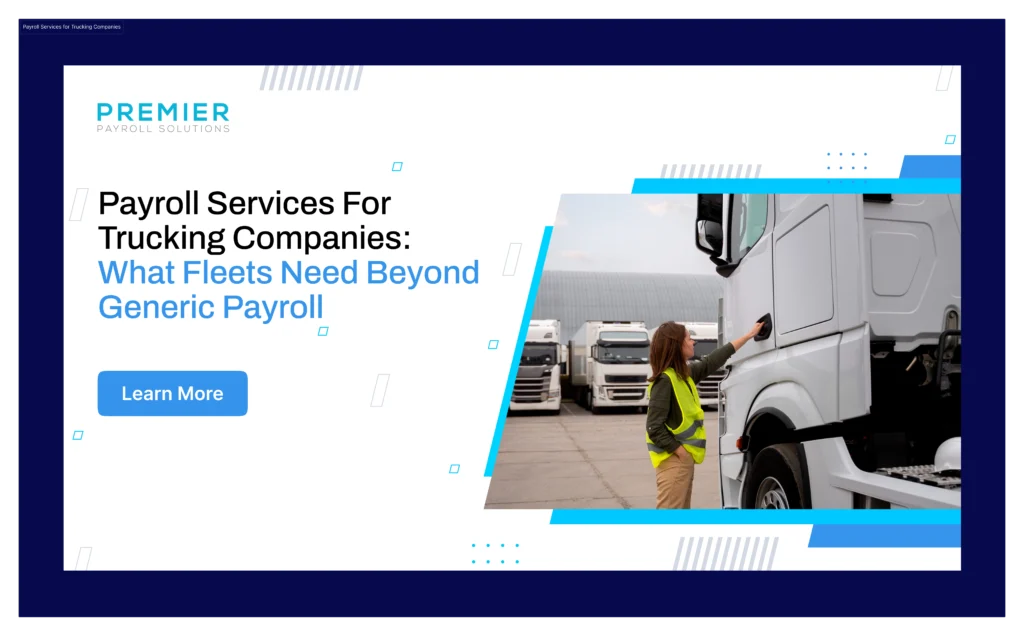
Payroll Services for Trucking Companies: What Fleets Need Beyond Generic Payroll
Get payroll services for trucking companies built for mixed pay, multi-state tax, and DOT compliance. Book a free consult.

Benefits Administration Software: Fix Enrollment Errors
Security Guard Payroll Software: 7 Features for Overnight, Multi-Site, and Union Teams
Payroll Integration Checklist: Connect HR, Time, Benefits, and Accounting Without Duplicate Data
Open Enrollment Software Checklist: What to Fix Before Q4 Benefits Season
It is 6:47 PM on a Thursday and Ray just got a call he did not want.
His top driver, the one who has been with him for four years, the one who never complains, is on the other end of the line asking why his check is short by 380 dollars. Again. Third time this quarter.
Ray is not a bad boss. He is a trucking company owner running eighteen trucks and forty employees, doing his absolute best with a payroll system that was built for offices, not highways. And tonight, like a lot of nights, that system just failed him in front of the one driver he cannot afford to lose.
If this story feels a little too familiar, you are exactly who this blog is for. This is exactly the gap that real payroll services for trucking companies are built to close, the kind that understands a fleet is nothing like a nine-to-five office.
Table of Contents
- The Night Every Trucking Owner Dreads
- Why Generic Payroll Software Falls Apart on the Highway
- The Real Price Tag of Getting Driver Pay Wrong
- The Multi-State Tax Problem Nobody Warns You About
- W-2 Drivers, 1099 Owner-Operators, One Payroll System
- DOT Compliance Is Not Optional, and Neither Is Getting It Right
- Fuel, Per Diem, and the Paper Trail That Never Ends
- What to Actually Demand From Payroll Services for Trucking Companies
- Why Trucking Companies Choose Premier Payroll for Multi-State Driver Pay
- Conclusion
- FAQs
- Key Takeaways
Why Generic Payroll Software Falls Apart on the Highway
Here is the plot twist most trucking owners do not see coming until it is too late. The payroll software that works beautifully for a dentist’s office or a retail shop was never built for a fleet.
Office payroll assumes one thing: everyone gets paid the same way, on the same schedule, for the same kind of work. Trucking blows that assumption apart in the first five minutes.
One driver gets paid by the mile. Another gets paid by the load. A third is hourly because he is running local routes. A fourth is an owner-operator who is not even on your W-2 payroll at all. Try feeding that mix into a system designed for nine-to-five office staff, and something is going to break, usually your driver’s paycheck, usually on a Friday.
This is exactly why generic software is not the same thing as payroll services for trucking companies. Software processes numbers. A real trucking-focused system understands the industry those numbers came from.
The Real Price Tag of Getting Driver Pay Wrong
Let’s talk about what a payroll mistake actually costs, because it is never just the 380 dollars Ray owed his driver.
A wrong paycheck costs you trust. Drivers talk to each other, and in an industry already fighting brutal turnover, one bad payroll experience can be the reason your best driver starts scrolling job boards during his next fuel stop.
And here is the twist nobody talks about: the businesses that switch to real payroll services for trucking companies almost always say the same thing afterward. They did not realize how much time and money they were bleeding until it stopped. That single realization is usually the moment a fleet owner starts actively searching for payroll services for trucking companies instead of just tolerating what they already have.
The Multi-State Tax Problem Nobody Warns You About
Picture this. Your driver leaves a warehouse in New Jersey on Monday, delivers in Pennsylvania on Tuesday, picks up a load in Ohio on Wednesday, and is back on Long Island by Friday.
That is not a route. That is a tax compliance nightmare waiting to happen.
Every state your trucks cross has its own withholding rules, its own thresholds, its own filing requirements. Get one state wrong, and you are not just facing a fine; you are facing a compliance mess that can take months to untangle.
This single issue is the number one reason trucking companies finally admit that spreadsheets and basic software cannot keep up. Multi-state filing done correctly, updated in real time as tax laws shift, is one of the non-negotiable pillars of trucking payroll services done right, and it needs to stay lined up with federal wage and overtime rules at every single stop along the route.
W-2 Drivers, 1099 Owner-Operators, One Payroll System
Most fleets are not running one type of workforce. They are running two, at the same time, under one roof.
You have your W-2 company drivers who need standard payroll, tax withholding, and benefits eligibility tracked. Then you have your 1099 owner-operators, who are contractors, not employees, and who need to be paid and filed completely differently.
Managing both inside the same clunky system is how mistakes happen. A driver gets miscategorized. A 1099 gets treated like a W-2. Suddenly you are looking at IRS scrutiny you never asked for.
The trucking companies that sleep well at night are the ones running trucking payroll services built specifically to handle both classifications inside one platform, without the manual gymnastics.
DOT Compliance Is Not Optional, and Neither Is Getting It Right
Every trucking owner already knows DOT compliance is serious business. What fewer owners realize is how much of that compliance runs straight through payroll.
Hours-of-service records need to line up with pay records. Certified payroll reports, when they apply to your contracts, need to be airtight. ELD data needs to sync cleanly with what your drivers are actually being paid for.
When payroll and compliance live in two disconnected systems, gaps appear. And gaps are exactly what auditors are trained to find.
FMCSA’s own regulatory guidance makes clear that recordkeeping accuracy is not a suggestion; it is the baseline. The trucking companies that treat payroll and compliance as one connected system are the ones who never have to sweat an audit call, and that connection is exactly what separates real payroll services for trucking companies from a generic timesheet tool with a payroll button bolted on.
Fuel, Per Diem, and the Paper Trail That Never Ends
Ask any trucking owner what eats the most admin hours in a week, and fuel reimbursements plus per diem tracking will be near the top of the list.
Receipts get lost. Per diem rates get applied inconsistently. Someone in the office is manually cross-checking mileage logs against fuel cards at 9 PM instead of going home.
This is not a people problem. It is a systems problem. The right trucking payroll services automate reimbursement tracking so it flows directly into payroll instead of living in a shoebox of receipts nobody wants to touch, and that alone is often the single biggest time-saver fleet owners report after switching.
For the tax side of reimbursements and mileage rates, the IRS guidance on contractor versus employee classification is worth every fleet owner bookmarking, because getting this wrong at tax time is its own special kind of headache.
What to Actually Demand From Payroll Services for Trucking Companies
By now the pattern should be obvious. Trucking payroll is not harder because trucking owners are bad at math. It is harder because the industry itself refuses to fit inside a generic box, which is exactly why payroll services for trucking companies exist as their own category in the first place.
So here is what to actually look for before you sign with anyone:
- Pay structure flexibility. Mileage, hourly, load-based, and day-rate pay, all inside one system.
- Multi-state tax filing that updates automatically as laws change across every state your trucks touch.
- 1099 and W-2 support in the same platform, without duplicate logins or duplicate data entry.
- Fast onboarding. New drivers and contractors need to be live within hours, not days.
- ELD and time-tracking integration so hours actually match pay.
- A real human who answers the phone when a driver’s check is wrong at 6:47 PM on a Thursday.
That last point matters more than most owners expect. When you call your provider with a problem, do you get a ticket number or a person? For a fleet running on tight margins and tighter schedules, that answer changes everything.
Why Trucking Companies Choose Premier Payroll for Multi-State Driver Pay
Every problem covered above- mixed pay structures, multi-state filing, 1099 and W-2 chaos, DOT-linked recordkeeping- is the exact reason Premier Payroll built its trucking payroll solutions around how fleets actually operate, not how a generic software template assumes they should.
Premier handles automated mileage-based, hourly, and per-load pay calculations inside one payroll platform, with multi-state tax filing that updates as laws shift, so your drivers get paid correctly no matter how many state lines they crossed that week. Owner-operators and W-2 drivers run through the same system without the manual reclassification work that trips up so many fleets, and new hires get onboarded through digital onboarding tools that put contractors and drivers live within hours, not days. For fleets tracking hours against ELD data, time and attendance tracking ties directly into payroll, and 100+ software integrations mean your existing ELD and fleet management tools do not need to be replaced, just connected.
The result speaks for itself. Fleets that move their payroll to Premier report 98% contractor satisfaction, driven largely by faster, more accurate payments and a dedicated payroll expert who actually answers the phone. That is what payroll services for trucking companies are supposed to feel like: one call, one person, one problem solved.
FAQs
What makes payroll for trucking companies different from regular payroll? Trucking payroll has to handle mileage, load, and hourly pay in one system, multi-state tax filing, and a mix of W-2 drivers and 1099 owner-operators, none of which standard payroll software is built to manage cleanly.
Can one payroll system handle both W-2 drivers and 1099 owner-operators? Yes, when the provider is built for it. Purpose-built payroll services for trucking companies run both classifications through one platform without manual reclassification errors.
How does multi-state tax filing work for trucking companies? Your provider should automatically apply the correct withholding and filing rules for every state your drivers cross, updated in real time as state laws change.
Do trucking payroll services handle fuel reimbursements and per diem? The right ones do. Reimbursement tracking should flow directly into payroll instead of requiring manual receipt matching every pay cycle.
How fast can new drivers or contractors be onboarded? With digital onboarding built for trucking, new hires and contractors can be live in the system within hours, not the days it takes with generic HR software.
Does trucking payroll connect with ELD systems? It should. Payroll that integrates with ELD and time-tracking data ensures drivers are paid accurately for the hours they actually worked and drove.
Is switching payroll providers risky for an active fleet? Not with a proper transition plan. A dedicated trucking payroll services provider migrates your fleet without a missed pay cycle or a gap in coverage.
How do I know if I actually need payroll services for trucking companies instead of standard payroll? If your drivers are paid different ways, cross state lines, or mix W-2 and 1099 status, standard payroll will eventually break. That combination is the clearest sign you need payroll services for trucking companies built for the industry, not adapted from a generic template.
Conclusion
Ray’s Thursday night phone call did not have to happen. Somewhere between mixed pay structures, multi-state tax rules, 1099 contractors, and DOT paperwork, generic payroll systems simply run out of road. Fleets that switch to purpose-built trucking payroll services are not just fixing a paycheck problem. They are removing an entire category of stress from running the business.
Key Takeaways
- Mixed pay structures, mileage, load, hourly, and day-rate, are the number one reason generic payroll software fails trucking companies.
- Multi-state tax filing errors are one of the most expensive and avoidable mistakes fleets make.
- W-2 drivers and 1099 owner-operators need to run through one system, not two disconnected processes.
- DOT compliance and payroll accuracy are directly linked, gaps in one create risk in the other.
- Fuel reimbursements and per diem tracking should be automated, not manually matched against receipts.
- Fast onboarding matters in an industry with high driver turnover and constant hiring.
- ELD integration ensures drivers are paid for actual hours worked, not estimates.
- Reliable trucking payroll services turn fuel and per diem reimbursements into an automated line item instead of a weekly paperwork chase.
- A dedicated payroll expert who answers the phone is worth more than any feature list.
- The right payroll services for trucking companies remove an entire category of operational stress, not just a paperwork task.
Ready to Stop Firefighting Payroll?
Talk to a real payroll expert today and find out what payroll services for trucking companies actually look like when they are built for the road, not the office.