
Blog.
The Future of Technology:
Trends to Watch
Employee Onboarding Software for Small Businesses: Forms, Training, Assets, and First Payroll
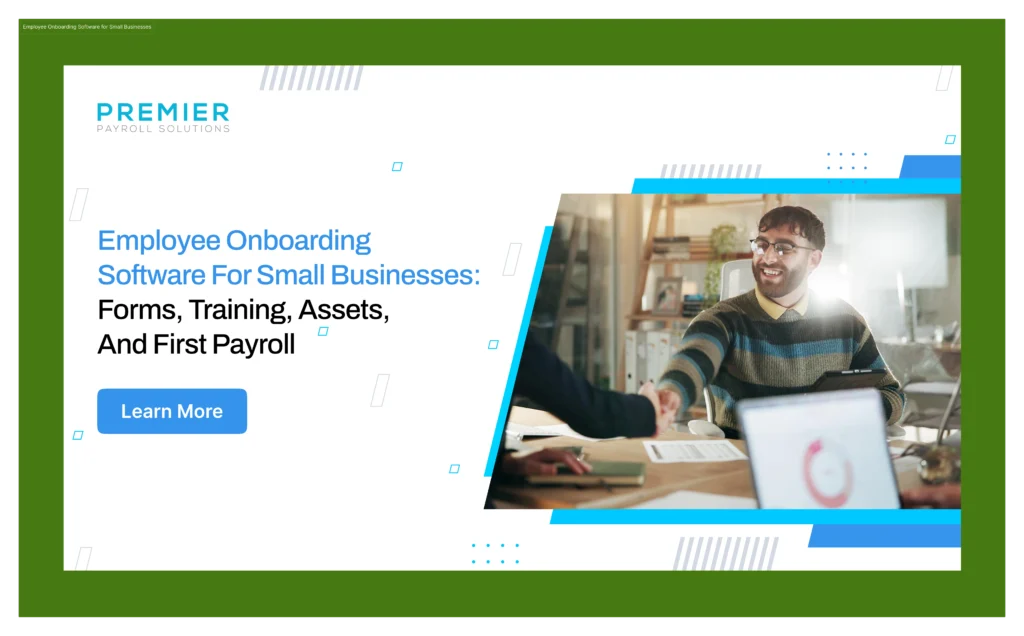
Employee Onboarding Software for Small Businesses: Forms, Training, Assets, and First Payroll
Employee onboarding software for small businesses. Forms, training, assets, and first payroll in one connected system.
Benefits Administration Software: Fix Enrollment Errors
Security Guard Payroll Software: 7 Features for Overnight, Multi-Site, and Union Teams
Payroll Integration Checklist: Connect HR, Time, Benefits, and Accounting Without Duplicate Data
Open Enrollment Software Checklist: What to Fix Before Q4 Benefits Season
Employee onboarding software should turn a new hire’s first week into a self-running checklist, not a scramble to find the right tax form buried in someone’s inbox. For a small business hiring its fifteenth or fiftieth employee, the difference between a smooth start and a messy one usually comes down to whether the paperwork, training, and first paycheck all live in one connected system or five disconnected ones.
Quick facts:
- A connected onboarding system should handle forms, training, equipment tracking, and payroll setup in one place
- Digital onboarding replaces paper stacks with a guided, step-by-step process a new hire can complete before day one
- HR employee onboarding software works best when it connects directly to payroll, not as a separate standalone tool
- Automated employee onboarding software reduces manual data entry, but someone still needs to review compliance-sensitive forms
- A new hire’s first payroll run depends entirely on how cleanly their onboarding data was captured upfront
Table of Contents
- Why Employee Onboarding Software Matters for Small Businesses
- Forms: What a Strong Onboarding System Should Handle on Day One
- Training and Compliance Inside the Onboarding Process
- Tracking Company Assets During Onboarding
- Connecting Onboarding to First Payroll
- HR Employee Onboarding Software vs Basic Digital Forms
- What to Look for in Automated Employee Onboarding Software
- Common Mistakes Small Businesses Make With Digital Onboarding
Why Employee Onboarding Software Matters for Small Businesses
A small business without a connected onboarding system usually runs the process the same way every time: a stack of paper forms, a few emailed PDFs, and someone manually re-entering the same employee data into three different systems. It works, until it does not. A missing signature or a delayed tax form can hold up someone’s first paycheck.
A system like this exists to remove that friction. It standardizes the process so every new hire gets the same complete, compliant experience, whether they are employee number three or employee number three hundred.
Forms: What a Strong Onboarding System Should Handle on Day One
The paperwork stage is where most manual onboarding breaks down. A good digital onboarding system should collect and store securely:
- I-9 employment eligibility verification
- W-4 tax withholding elections
- Direct deposit banking information
- Emergency contact and personal details
- Signed offer letters and policy acknowledgments
Digital onboarding means a new hire can complete all of this before their first day, from any device, without a single form getting lost in transit. That alone removes one of the most common reasons a first paycheck runs late.
Training and Compliance Inside the Onboarding Process
Forms are only half the picture. The same system should also route new hires through required training and track it automatically, whether that is a safety certification, a harassment policy acknowledgment, or role-specific skills content.
Automated employee onboarding software can flag exactly who has completed the required training and who has not, without HR having to chase down individual employees for confirmation. For industries with real compliance stakes, restaurants, security, and healthcare among them, that tracking is not optional. It is the difference between a clean audit and a scramble to prove training happened.
Tracking Company Assets During Onboarding
Laptops, badges, uniforms, keys, phones. Every new hire receives something, and most small businesses track it on a spreadsheet that goes stale within a month. The same system should log every asset issued during onboarding and automatically flag it when that employee eventually leaves.
This matters more than it sounds. A missing badge or an unreturned laptop after an employee exits is a security and cost issue, and it almost always traces back to onboarding records that were never properly kept.
Connecting Onboarding to First Payroll
Here is where most onboarding tools fall short. They collect the forms, but they do not talk to payroll. That gap means someone still has to manually enter W-4 details, direct deposit information, and pay rate into a separate payroll system, introducing the very kind of error that onboarding software was supposed to prevent.
A system that connects directly to payroll processing means a new hire’s data flows straight into their first paycheck setup. No re-entry, no missed field, no delay waiting on someone to key in banking details manually before the pay run closes.
HR Employee Onboarding Software vs Basic Digital Forms
Not every “digital onboarding” tool is doing the same job. Some just replace paper with a PDF form. Others manage the full employee lifecycle.
| Approach | What It Covers | What’s Missing |
| Basic digital forms | E-signatures, form storage | No payroll connection, no training tracking |
| HR employee onboarding software | Forms, training, compliance, asset tracking, payroll sync | Requires a system built for the full process, not just paperwork |
HR employee onboarding software earns its name when it manages the entire new hire journey, not just the signature step. If a tool only digitizes forms, the business is still doing the connecting work manually behind the scenes.
What to Look for in Automated Employee Onboarding Software
Before choosing a platform, check it against what actually matters for a growing business.
- Does it connect directly to your payroll system, or require manual re-entry?
- Does it track required training and flag incomplete items automatically
- Does it log company assets and offboard them cleanly when someone leaves
- Can a new hire complete it remotely, before their first day
- Is there a real person to call if something in the process breaks
Automated employee onboarding software that skips any of these usually just moves the manual work somewhere less visible instead of removing it.
Common Mistakes Small Businesses Make With Digital Onboarding
- Choosing forms-only software. Digital onboarding that stops at e-signatures still leaves payroll and training disconnected
- Not connecting onboarding to payroll. This is the single biggest cause of delayed first paychecks
- Skipping asset tracking. Equipment issued during onboarding needs to be logged from day one, not reconstructed later
- Assuming automation means zero review. Compliance-sensitive forms like the I-9 still need a human checking accuracy
- Treating onboarding as a one-time event. Offboarding and rehires need the same system working in reverse
How Premier Payroll Powers Onboarding for Growing Businesses
Premier Payroll Solutions built its electronic onboarding wizard to handle the entire new hire journey, not just digital forms. New hires complete I-9s, W-4s, direct deposit, and policy acknowledgments remotely, and that data flows directly into payroll processing so the first paycheck is accurate without anyone re-entering a single field.
Required training and compliance documentation get tracked automatically, and employees can check their own status anytime through employee self-service. For companies managing shift-based teams, onboarding connects directly to time and attendance, and benefits enrollment ties in with benefits and ACA administration, all running on the same platform via 100+ software integrations.
New hires can be live in the system within hours, not days, backed by a dedicated payroll expert and 24/7 live human support for anything the automated process cannot resolve on its own.
FAQs
Q: What should employee onboarding software actually include? It should handle digital forms like I-9s and W-4s, required training tracking, company asset logging, and a direct connection to payroll so first paychecks are accurate.
Q: Is HR employee onboarding software different from basic digital forms tools? Yes. HR employee onboarding software manages the full new-hire journey, including forms, training, compliance, and payroll sync, while basic digital forms tools only handle e-signatures.
Q: Does automated employee onboarding software remove the need for human review? No. Automation reduces manual entry, but compliance-sensitive forms like I-9s still require a human to confirm accuracy before they are finalized.
Q: How does digital onboarding affect a new hire’s first paycheck? When onboarding data flows directly into payroll, a new hire’s first check is calculated correctly without manual re-entry, reducing the chance of a delayed or inaccurate payment.
Q: Can this kind of system track company equipment? Yes, a well-built system logs assets like laptops and badges issued at onboarding and flags them automatically when the employee eventually offboards.
Q: How fast can a new hire be onboarded with the right software? With a connected system, new hires can complete forms and be entered into payroll within hours, rather than the days it typically takes with a manual paper process.
Conclusion
Employee onboarding software is only as useful as the extent to which it connects the pieces. Forms, training, asset tracking, and first payroll all need to work off the same data, not five separate systems a small business has to stitch together manually. Digital onboarding delivers real value only when it removes manual handoffs entirely, not just the paper.
According to U.S. Citizenship and Immigration Services, every employer is legally required to complete Form I-9 for each new hire to verify identity and employment eligibility, and the IRS requires a completed W-4 before an employee’s first paycheck can be processed correctly.
Ready to stop manually chasing new-hire paperwork? Get a free onboarding and payroll review from Premier Payroll Solutions and see what employee onboarding software should actually look like.
Key Takeaways
- Employee onboarding software should connect forms, training, assets, and payroll in one system
- Digital onboarding replaces paper stacks with a guided process a new hire completes remotely
- HR employee onboarding software manages the full new hire journey, not just e-signatures
- Automated employee onboarding software still needs human review for compliance-sensitive forms
- Connecting onboarding directly to payroll is the biggest fix for delayed first paychecks
- Training and compliance tracking should be automatic, not chased down manually by HR
- Asset tracking at onboarding prevents costly equipment losses later at offboarding
- Choosing forms-only software leaves the payroll and training gap unsolved
- New hires can go live in hours, not days, when systems are properly connected
- A real human should be reachable when the automated process hits something it cannot resolve