
Blog.
The Future of Technology:
Trends to Watch
Employee Scheduling Software for Multiple Locations: What Payroll Teams Need
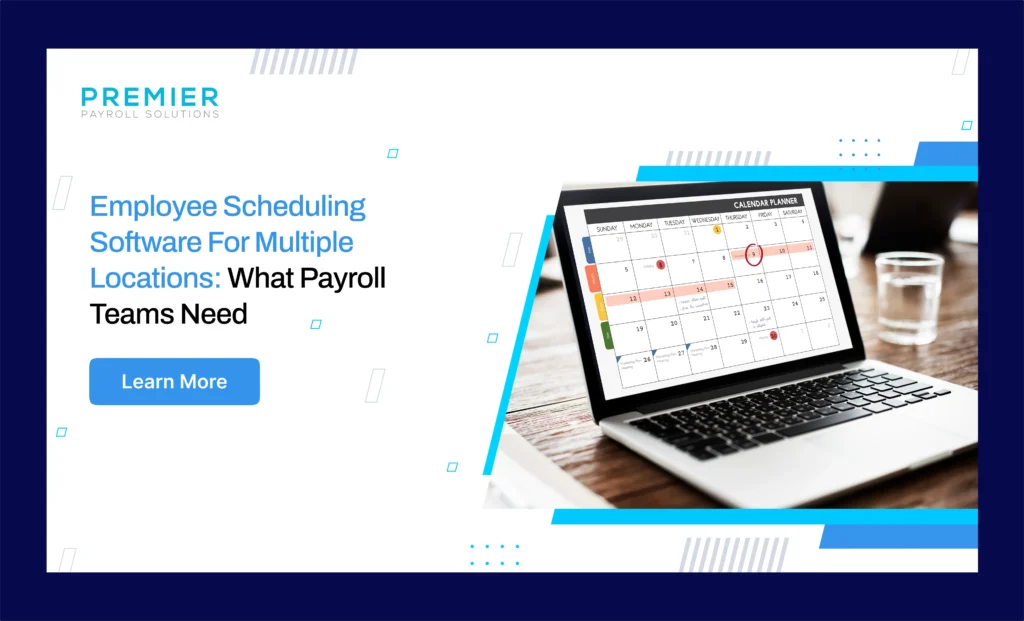
Employee Scheduling Software for Multiple Locations: What Payroll Teams Need
Compare employee scheduling software for multiple locations that connects directly to payroll and reduces manual errors.

Benefits Administration Software: Fix Enrollment Errors
Security Guard Payroll Software: 7 Features for Overnight, Multi-Site, and Union Teams
Payroll Integration Checklist: Connect HR, Time, Benefits, and Accounting Without Duplicate Data
Open Enrollment Software Checklist: What to Fix Before Q4 Benefits Season
Employee scheduling software for multiple locations gets sold on calendar views and drag-and-drop shifts, but the feature that actually matters is whether it talks to payroll. Shift scheduling software that lives in its own bubble just creates a second data set someone has to reconcile with actual paychecks every week. The right scheduling and payroll software rolls hours from every site into one accurate pay run automatically, so managing four locations doesn’t mean four separate headaches every Friday.
You’ve got four locations, forty employees, and a Sunday night ritual of texting three different managers to confirm who’s actually working Monday morning. If that sounds exhausting, you’re not managing a scheduling problem anymore. You’re managing a payroll problem in a scheduling costume, and you need employee scheduling software for multiple locations that actually integrates with your payroll system.
Here’s what most business owners get wrong when they start shopping. They look for the app with the prettiest calendar view. But the real test of employee scheduling software for multiple locations isn’t how it looks on a manager’s phone. It’s what happens when those scheduled hours have to turn into an accurate paycheck across four different sites, four different managers, and sometimes four different pay rates.
Quick Answer: What to Look For First
- Employee scheduling software for multiple locations should sync directly with payroll, not create a second data set to reconcile
- Employee scheduling software needs to handle last-minute changes across sites without a manager calling three people
- Scheduling and payroll software should track hours by location automatically for accurate labor cost reporting
- Multi-location businesses need role-based access so each site manager only sees their own team
- Compliance features matter more with multiple locations, especially across state or city lines
Table of Contents
- Why Multi-Location Scheduling Breaks Down Without Payroll Connected
- What Employee Scheduling Software for Multiple Locations Actually Needs to Do
- The Must-Have Features Checklist
- Shift Scheduling Software: Where Most Multi-Site Businesses Get Stuck
- Common Mistakes Businesses Make Choosing Scheduling Software
- How to Evaluate a Vendor Before You Commit
- How Premier Payroll Connects Scheduling and Payroll Across Locations
- Conclusion
- FAQs
- Key Takeaways
Why Multi-Location Scheduling Breaks Down Without Payroll Connected
Here’s the problem nobody warns you about before you sign a contract. Most scheduling apps are built to solve one thing: covering shifts. They’re not built to ensure those shifts translate into accurate paychecks at the end of the week.
That gap doesn’t matter much with one location and eight employees. It matters a lot when you’ve got four sites, different managers building schedules independently, and payroll due Friday whether the numbers are clean or not. Someone ends up exporting spreadsheets from four separate systems, manually merging them, and hoping nothing got missed.
That’s exactly why employee scheduling software for multiple locations needs to be evaluated as part of your payroll process, not as a separate tool you bolt on afterward. Employee scheduling software that ignores payroll just shifts the manual work later in the week instead of removing it.
What Employee Scheduling Software for Multiple Locations Actually Needs to Do
A five-location retail chain and a two-site professional services firm need different things from their scheduling setup, but the foundation should be the same.
For hourly, shift-based teams across multiple sites, employee scheduling software needs to prevent overlapping shifts, flag overtime before it occurs, and let managers adjust coverage without a dozen phone calls.
For businesses that span state or city lines, your scheduling and payroll software must automatically account for different labor laws. A shift that’s fine in one location might trigger overtime or break requirements in another.
For growing multi-site operations, role-based permissions matter. Each location manager should see and edit their own team’s schedule without accessing another site’s data, while ownership still maintains a unified view across all sites.
The Must-Have Features Checklist
Run every option through this list before you commit to anything:
- Direct payroll integration. Scheduled and actual hours worked should flow into payroll without a manual export step.
- Location-based scheduling views: managers see only their site, while owners see everything.
- Real-time shift swaps and coverage requests, especially for businesses where call-outs happen often.
- Automatic overtime flagging based on hours across a single employee’s shifts, even if they work at more than one location.
- Labor cost reporting by site, so you know which location is running over budget before the pay period closes.
- Mobile access for employees and managers, since most schedule changes happen away from a desk.
- Compliance alerts for multi-state or multi-city rules, including required break periods and local overtime thresholds.
If a platform is missing more than one of these, it’s not real employee scheduling software for multiple locations. It’s single-location software with a location dropdown added on top.
Get a Free Scheduling and Payroll Quote
Want to see what a fully connected, multi-location system would cost your business? Click here to get a quote and get a straightforward breakdown, no obligation.
Shift Scheduling Software: Where Most Multi-Site Businesses Get Stuck
Here’s where things fall apart for many growing businesses. They pick shift scheduling software that looks solid for one location, only to discover it wasn’t designed for multiple sites when they expand. Each new location becomes its own island, with its own schedule, its own manager habits, and its own reconciliation headache at payroll time.
Real employee scheduling software for a multi-location business means every site feeds into one central view, hours roll up automatically by location, and nobody has to manually stitch together four spreadsheets to figure out what actually got worked. According to the U.S. Department of Labor, employers are responsible for maintaining accurate records of hours worked regardless of how many locations or shifts are involved, and that responsibility doesn’t get lighter with more sites; it gets heavier.
Common Mistakes Businesses Make Choosing Scheduling Software
You’re not the first to shop for this, and these mistakes trip up most multi-location owners:
- Choosing employee scheduling software that doesn’t connect to payroll. You’ll still have to manually reconcile hours every cycle.
- Underestimating role-based access needs. Without it, every manager sees every location, which gets messy fast.
- Ignoring compliance differences between locations. A rule that applies in one city might not apply in another.
- Picking software based on the mobile app design alone. A nice interface doesn’t fix a broken payroll connection.
- Not planning for growth. What works for two sites often breaks down at six.
How to Evaluate a Vendor Before You Commit
Before you commit to any employee scheduling software, ask these questions:
- Does this connect directly to payroll, or do I still need to export hours manually?
- Can each location manager see only their own team’s schedule?
- How does the system handle overtime for someone working shifts at two different sites?
- If a compliance rule changes in one of my locations, does the software update automatically?
That last question matters more as you add locations. Manual compliance tracking across multiple cities or states is where most scheduling mistakes start.
How Premier Payroll Connects Scheduling and Payroll Across Locations
Premier Payroll Solutions builds time and attendance tracking that connects directly to the same platform running your payroll processing, so scheduled and actual hours from every location roll into a single accurate paycheck without a manual export or spreadsheet merge. Managers at each site see their own view, while ownership can see labor costs and hours across all locations in one place.
For businesses managing teams across city or state lines, multi-state compliance support is built into the same system, so overtime rules, break requirements, and local labor laws are tracked automatically instead of manually per site. Restaurant groups with multiple branches build restaurant payroll around split shifts and tip tracking, and property management companies allocate hours by property through property management payroll. Every employee also gets self-service access to check hours and pay stubs regardless of which location they’re working at, and accounts connect to 100+ software integrations with existing scheduling and timekeeping tools.
When a schedule change causes a payroll question on a Friday afternoon, Premier clients get 24/7 live human support from a dedicated payroll expert who already understands their multi-location setup.
Why Multi-Location Businesses Choose Premier Payroll
- Scheduled and actual hours from every site roll into one paycheck, with no manual merge
- Managers see only their own location, while ownership sees labor costs across all sites
- Multi-state compliance for overtime, breaks, and local labor laws tracked automatically
- Industry-specific support for restaurant groups and property management companies
- Employee self-service across every location for hours and pay stubs
- 100+ integrations connect existing scheduling and timekeeping tools without a rebuild
- 24/7 live human support from a dedicated payroll expert who knows the multi-location setup
Talk to a Real Payroll Expert
Tired of reconciling spreadsheets from every location every pay period? Call us at 631-403-5088 and talk to a real payroll expert about connecting scheduling and payroll across all your sites.
FAQs
What is the best employee scheduling software for multiple locations? The best employee scheduling software for multiple locations connects directly to payroll, supports role-based access by site, and automatically flags overtime across all locations an employee works.
How is shift scheduling software different for multi-location businesses? Single-location shift scheduling software often can’t roll hours up across sites automatically. This kind of software needs centralized reporting and location-based permissions built in from the start.
Why does scheduling and payroll software need to be connected? Without that connection, someone has to manually export and reconcile hours from every location every pay period, which is where most payroll errors happen.
Can employee scheduling software for multiple locations handle different compliance rules per city or state? Yes, and it should. Labor laws vary by location, and your software needs to flag overtime and break requirements automatically based on where an employee is working.
Is scheduling software worth it for a business with only two or three locations? Yes. Even with a small number of sites, manual reconciliation between separate schedules and payroll eats hours every week that add up fast.
What happens if an employee works shifts at two different locations in the same week? Good scheduling and payroll software tracks combined hours across both locations to calculate overtime correctly, rather than treating each site as a separate employee record.