
Blog.
The Future of Technology:
Trends to Watch
Payroll for Small Business: DIY vs Outsourcing
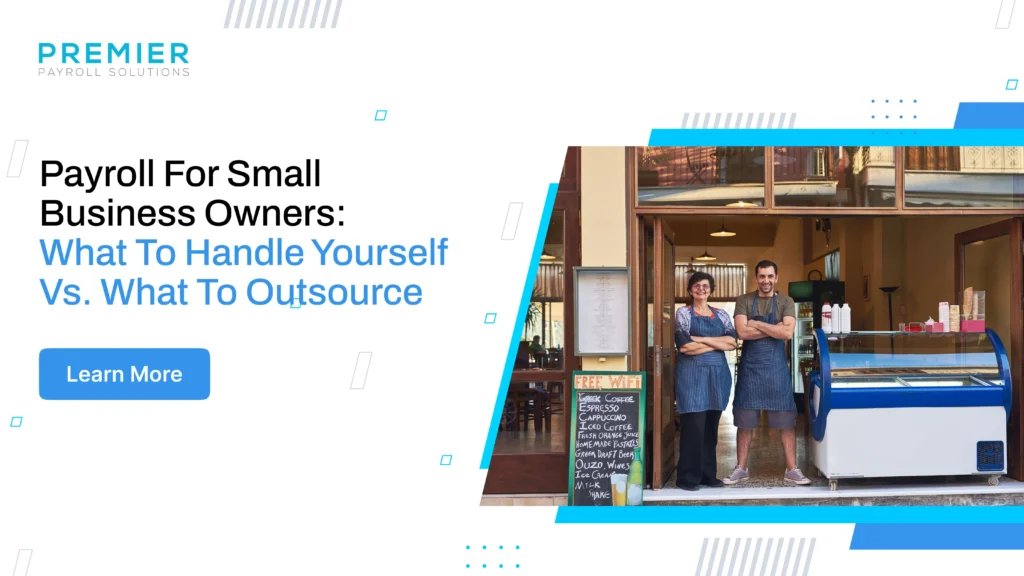
Payroll for Small Business: DIY vs Outsourcing
Should you handle payroll yourself or outsource? Find out the hidden costs, time commitment, and when it's time to pass the torch.

Payroll Budgeting: How Small Businesses Should Plan Payroll Costs
Employee Scheduling Software for Multiple Locations: What Payroll Teams Need
Benefits Administration Software: Fix Enrollment Errors
Security Guard Payroll Software: 7 Features for Overnight, Multi-Site, and Union Teams
Sunday night, 11:47 PM. You’re still at your desk, hunched over a spreadsheet with your coffee gone cold, because Maria called out sick and her hours weren’t entered into the system. Overtime calculations are glitching. Someone reported a missing direct deposit from last week. And you have exactly 47 minutes to process payroll before the bank deadline Tuesday morning.
This moment hits different when it’s your business on the line.
The question isn’t whether payroll matters. Every business owner knows payroll is literally the heartbeat of their company. The real question is whether you should handle payroll for small business owners yourself or hand it off to someone who does it every single day.
The answer isn’t obvious. And it costs you real money to get it wrong.
DIY Payroll for Small Business Owners: The Real Cost Nobody Talks About
Let’s do some math that will shock you.
You’re spending 4 to 6 hours every week on payroll. That’s roughly 250 hours per year. Now multiply that by what you actually earn per hour running your business. For a business generating $100K annually, that’s your time worth somewhere around $50 to $75 per hour. For businesses at $250K or higher, you’re looking at double that.
That means DIY payroll for small business owners is costing you $12,500 to $37,500 in lost productivity annually. And that’s before the software subscriptions, tax-filing fees, and accounting headaches.
But the real cost isn’t the hours. It’s what you’re not doing during those hours.
You’re not landing new clients. You’re not solving operational problems. You’re not having the kind of strategic conversations that actually move your business forward. You’re checking boxes on a spreadsheet, and every hour you spend there is an hour you’re not building something bigger.
The worst part? You probably didn’t account for this cost when you decided to DIY.
The Three Hidden Dangers of Handling Payroll In-House
Danger 1: One Person Knows Everything (And Then They Leave)
Here’s a scenario that plays out more often than you’d think. You’ve got one team member who handles payroll. They know where all the files live, they know why you calculate tips the way you do, they understand the quirks of your system. They’re golden.
Then they leave.
And suddenly you’re staring into a void. Passwords you don’t remember. Processes you never documented. Tax deadlines approaching fast. A new hire sitting in the office waiting for their first paycheck, which should have been processed three days ago.
If you’re doing payroll yourself, you ARE that single point of failure. And if something happens to you, your business is in trouble.
Danger 2: Compliance Changes That Sneak Up On You
New York State changes the spread-of-hours rule. FICA tip credit calculations shift. IRS withholding tables update. ACA compliance requirements tighten. These aren’t rare events. They happen constantly, and each one has teeth.
Miss one compliance requirement and suddenly you’re liable for back wages, penalties, and legal exposure you didn’t see coming. You’re not a tax attorney or a compliance expert. You shouldn’t have to be.
The financial hit from a single compliance error can wipe out months of payroll savings. We’re talking about tens of thousands of dollars in penalties, fines, and legal fees.
Danger 3: The Math Mistakes That Cost More Than You Save
Overtime calculation errors. Tips applied incorrectly. Tax withholding miscalculations. Garnishment deductions that don’t process.
Each mistake costs time to fix. It costs employee trust when someone’s paycheck is wrong. It costs money to issue corrections. And if you’re a restaurant owner managing tipped employees across multiple shifts, the complexity multiplies fast.
One owner we know spent 8 hours fixing a FICA tip credit error that cost them $3,200 in penalties. They tried to save money by doing it themselves. It cost them more than outsourcing would have for an entire year.
When DIY Payroll Actually Makes Sense (Spoiler: It’s Rare)
Let’s be honest: there are scenarios where DIY works for payroll for small business owners.
If you have 2 to 3 W-2 employees, simple salary structures, no tipped income, no state-specific complexity, and you genuinely have the headspace to manage it, you might make DIY work. You’d use something like Premier Payroll, QuickBooks, ADP’s basic plan, or Gusto. The software does heavy lifting. Your job is data entry and hitting send.
But even then, there’s a clock on this. The moment you add:
A second location, tipped employees, multi-state operations, contractors alongside W-2 staff, union agreements, complex shift structures
DIY stops making sense. The complexity increases faster than your capacity can handle. And you slip from “this is manageable” to “this is becoming a liability.”
The Outsourcing Trade-Off: What You Gain, What You Give Up
What You Gain:
When you outsource payroll, you get back those 250 hours per year. You get your peace of mind back. You get a real human you can call when something breaks, not an automated system or a ticket queue.
You get compliance confidence. Someone else is watching tax law changes, making sure your business stays compliant, taking accountability when something goes wrong. You get accuracy that you probably weren’t delivering yourself because you’re not doing this 500 times a day like they are.
You get integrations with your existing tools. POS systems, time-tracking, accounting software, 401(k) platforms. Everything talks to everything. Your payroll data flows seamlessly instead of sitting in disconnected silos.
And you get the mental space to actually think about growing your business instead of drowning in spreadsheets.
What You Give Up:
You give up the illusion of complete control. You’re trusting someone else with sensitive employee data, tax-filing responsibilities, and the accuracy your business depends on. That requires choosing a partner carefully, not just picking the cheapest option.
You give up a small percentage of your payroll budget. But when you do the math on your actual time, the compliance risk, and the error costs, that percentage is usually way smaller than it feels.
You give up the ability to “just quickly fix something” on your own terms. Instead, you’re working within someone else’s processes and timelines. That’s actually a feature when you’re working with the right partner, but it can feel like a loss at first.
Payroll for Small Business Owners: The Decision Framework Every Owner Needs
Ask yourself these five questions, in order.
Question 1: How Many Employees Do You Have?
If you have fewer than 10 employees and a simple structure, DIY is possible. Between 10 and 50, it’s getting risky. Above 50, it’s professionally irresponsible. The complexity scales faster than the value of keeping it in-house.
Question 2: How Much Is Your Time Actually Worth?
Multiply your business’s annual revenue by 0.30. Divide by 2000 hours. That’s roughly your hourly value when you’re working at full capacity. If DIY payroll costs you more than 10 to 15 percent of that hourly rate each year, you’ve already lost the financial argument.
Question 3: Do You Have Industry Complexity?
Running a restaurant? Complexity is high. Tipped employees. Spread of hours rule. Shift calculations. POS integration.
Managing security guards across multiple locations? Complexity is high. Union dues. Multi-rate pay structures. Multiple locations. Overtime variance.
Trucking company? Complexity is high. Multi-state operations. Contractor management. Mileage tracking.
The more specialized your industry, the more professional your payroll needs to be.
Question 4: What Happens If You Make a Mistake?
For a retail business, a payroll error stings but usually gets fixed. For a restaurant business, it erodes employee trust fast in an industry with thin margins and high turnover. For a security firm or trucking company, one compliance error can trigger government investigations and six-figure penalties.
Question 5: Where Are You Realistically Spending Those 4-6 Hours Per Week?
Be honest. Are you using this time to grow your business, or to keep the lights on? If it’s the latter, you’re already in trouble.
Why Premier Payroll is the Go-To for Small Business Owners
The tension in every payroll decision comes down to this: you need accuracy, compliance, and human accountability, but you don’t have unlimited budget.
Premier Payroll Solutions was built by people who get it. They run businesses. They understand the operational reality of managing a small team, dealing with shifting schedules, navigating compliance rules that seem designed to confuse, and trying to keep costs under control while keeping employees happy.
Here’s what changes when you partner with Premier instead of going it alone for payroll for small business owners:
A dedicated payroll expert becomes your go-to person. Not a call center. Not a ticket queue. Not tier-2 support after you’ve already waited two hours. An actual human who knows your business, understands your industry, and picks up the phone when something breaks. For restaurants, that means someone who actually understands tip compliance, shift calculations, and POS integration. For security companies, it means someone who’s handled union dues, multi-rate structures, and government-certified payroll before. For trucking companies, that means expertise in mileage-based pay, multi-state compliance, and 1099 contractor management.
That difference is not subtle. It changes how payroll feels from a compliance headache into a genuine partnership.
The technology handles the complexity you shouldn’t have to manage manually. Premier’s platform integrates with 100+ software systems, from QuickBooks and Gusto to your POS and time-tracking tools. Your data flows automatically. Errors drop dramatically because there’s no manual data-entry step where problems can hide.
Compliance becomes someone else’s responsibility. Tax law changes, regulatory updates, withholding calculations, deadline management. You’re covered. Premier keeps tabs on New York’s spread-of-hours rules, FICA compliance, ACA requirements, and every other regulation that could create liability. You’re not scrambling to figure it out on your own. You’re not facing penalties because you missed a deadline or misinterpreted a rule.
The Financial Piece:
Pricing for Premier’s payroll services starts at a point that competes directly with software-only solutions like Gusto, but with actual human support included. No “if you need help, upgrade your plan” games. No tier-based support where real help costs extra.
For most small businesses, outsourcing payroll for small business owners to Premier costs less than the time value of what you’re spending on DIY, plus the compliance risk you’re carrying, plus the error costs you’re not accounting for.
The math works. The peace of mind is just the bonus.
FAQs
Q: How much does it cost to outsource payroll compared to DIY? DIY software runs $30 to $75 per month, but doesn’t account for your time (worth $12K-$37K annually), compliance risk, or error costs. Outsourced payroll typically ranges from $50 to $150 per employee per month depending on complexity, but includes dedicated support and legal accountability. The math usually favors outsourcing.
Q: What happens to my data if I switch payroll providers? Professional payroll providers handle migration as part of their standard process. You maintain complete control of your data. Premier Payroll, for example, ensures zero payroll downtime during transitions and guides you through the entire data handoff with no gaps.
Q: Can I switch back to DIY payroll if outsourcing doesn’t work out? Yes. Most businesses that try outsourcing and then revert to DIY do so because they chose the wrong partner, not because outsourcing doesn’t work. If you find the right fit, you won’t want to switch back.
Q: Is outsourcing payroll safe for sensitive employee data? Reputable payroll providers use enterprise-grade security, encrypt all data in transit and at rest, and maintain compliance with GDPR, CCPA, and other privacy standards. Your data is actually safer with a specialized provider than with in-house management.
Q: How quickly can I get set up with an outsourced payroll provider? Most providers can get you live within 1 to 2 weeks, depending on data complexity. Premier gets new clients live within days and handles the transition from your previous system seamlessly.
Q: What if I have a unique payroll situation? That’s exactly why outsourced payroll exists. Complex situations (restaurants with tipped employees, trucking companies with multi-state operations, security firms with union contracts) are where outsourcing creates the most value. Generic software struggles. People-powered support solves it.
Q: Can a payroll provider integrate with my current tools? Yes. Premier Payroll integrates with QuickBooks, Gusto, time-tracking systems, POS platforms, 401(k) providers, and 100+ other tools. If you’re worried about integration, ask any potential partner upfront. It’s table stakes.
Conclusion
The right payroll decision isn’t the one that feels cheapest. It’s the one that lets you run your business without losing sleep.
DIY payroll for small business owners works for micro-businesses with simple structures and sufficient time to manage it properly. Everyone else pays a hidden cost in time, compliance risk, and the operational friction of managing something that wasn’t built to be managed well in-house.
Outsourcing isn’t giving up control. It’s choosing accountability. It’s choosing accuracy over convenience. It’s choosing a partner who cares about compliance as much as you do.
The businesses that grow fastest aren’t the ones saving money on payroll. They’re the ones that freed up their own time and mental space to focus on what actually moves the needle.
Key Takeaways
- Doing payroll yourself costs you 250+ hours annually, worth $12K–$37K in lost business productivity.
- Compliance errors, single-person dependencies, and calculation mistakes create hidden costs that often exceed DIY savings.
- DIY payroll works only for micro-businesses with 2–3 simple W-2 employees. Complexity becomes unmanageable quickly as a business grows.
- Outsourcing payroll frees up mental bandwidth for strategic growth while shifting compliance responsibilities to experienced professionals.
- For most small businesses, the math favors outsourcing once you factor in time, compliance risk, and the cost of payroll errors.
- Dedicated human support is more valuable than software-only solutions when unexpected issues or regulatory changes arise.
- Industry-specific payroll expertise, such as for restaurants, security companies, and trucking businesses, is difficult and time-consuming to build in-house.
- Professional payroll providers typically offer stronger data security than businesses that manage sensitive payroll information in-house.
- Switching payroll providers is generally straightforward and can be completed without disrupting your payroll schedule.
- The right payroll partner becomes a strategic business asset rather than just a vendor handling payroll tasks.
Ready to move payroll off your plate and get those hours back? Talk to a payroll expert today. Get your free payroll assessment and see exactly how much time you could reclaim.